Pallet Flow Racking System Manufacturer | HEDA
  • Warehouse Gravity Flow Racking System
  • Warehouse Gravity Flow Racking System
  • Warehouse Gravity Flow Racking System
  • Warehouse Gravity Flow Racking System
  • Warehouse Gravity Flow Racking System
  • Warehouse Gravity Flow Racking System
  • Warehouse Gravity Flow Racking System
  • Warehouse Gravity Flow Racking System

Pallet Flow Racking System for Warehouse Storage

No.GFRS01
HEDA Pallet Flow Racking System is a high-density warehouse storage solution designed for First-In, First-Out (FIFO) inventory management. Featuring gravity-assisted roller lanes, it enables pallets to move smoothly from the loading end to the retrieval end, improving storage efficiency, stock rotation, and warehouse space utilization. Custom configurations are available to suit different pallet sizes, load requirements, and warehouse layouts.
Download
View all downloads
  • Description

  • Specification

  • FAQ

HEDA SHELVES / PALLET FLOW STORAGE

Pallet Flow
Racking System

Engineered for high-density pallet storage and first-in, first-out (FIFO) inventory rotation, HEDA pallet flow racking uses inclined roller lanes to move compatible pallet loads between dedicated loading and unloading positions.

First-In, First-Out Inventory Flow
High-Density Pallet Storage
Gravity-Assisted Roller Lanes
Project-Specific Warehouse Layouts
GET QUOTE NOW
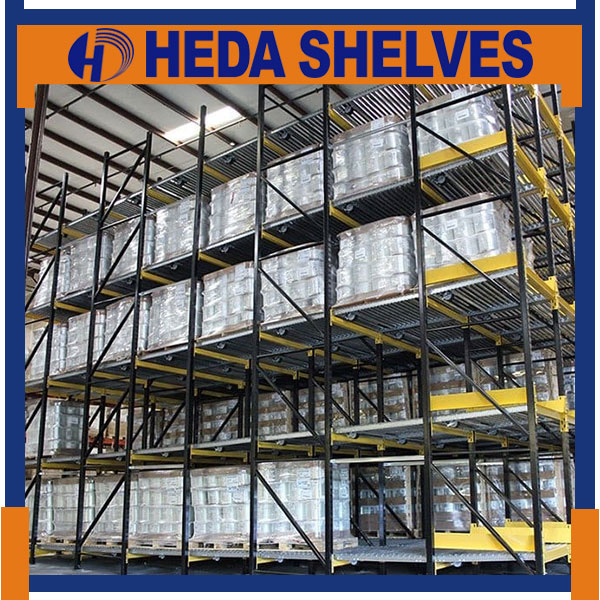
HEDA pallet gravity flow racking system with multi-level steel frames and roller tracks HEDA ORIGINAL PRODUCT REFERENCE
Gravity-powered pallet storage FIFO / DEEP-LANE STORAGE
01 / STOCK ROTATION

FIFO Inventory Control

Earlier-loaded pallets are positioned for retrieval first, supporting consistent batch and date-based stock rotation.

02 / SPACE UTILIZATION

High-Density Storage

Deep pallet lanes allow multiple pallets to be stored in sequence, reducing intermediate access aisles.

03 / MATERIAL FLOW

Gravity-Assisted Handling

Inclined roller tracks move compatible pallets toward the retrieval end without a powered lane drive.

Operating Principle

How Does Pallet Flow Racking Work?

Pallets are loaded from the elevated end of an inclined roller lane and travel toward the opposite retrieval end. This operating arrangement supports FIFO inventory rotation.

HEDA industrial pallet flow racking showing steel roller lanes and pallet support structures
Actual HEDA gravity roller lane structure
01

Load the Pallet

A forklift places a compatible pallet onto the roller lane from the higher loading end.

02

Move Under Gravity

The pallet travels along the inclined rollers. Movement and stopping behavior are controlled by the engineered lane arrangement.

03

Retrieve in FIFO Order

The earliest loaded pallet is retrieved from the opposite end. Remaining pallets advance toward the discharge position.

Simplified Pallet Flow Direction
LOAD PALLET
→
GRAVITY ROLLERS
→
FIFO RETRIEVAL
Product Construction

Built Around Reliable Pallet Movement

A pallet flow system combines a supporting steel rack structure with correctly configured roller lanes. Both elements must be designed according to the pallet loads and intended handling method.

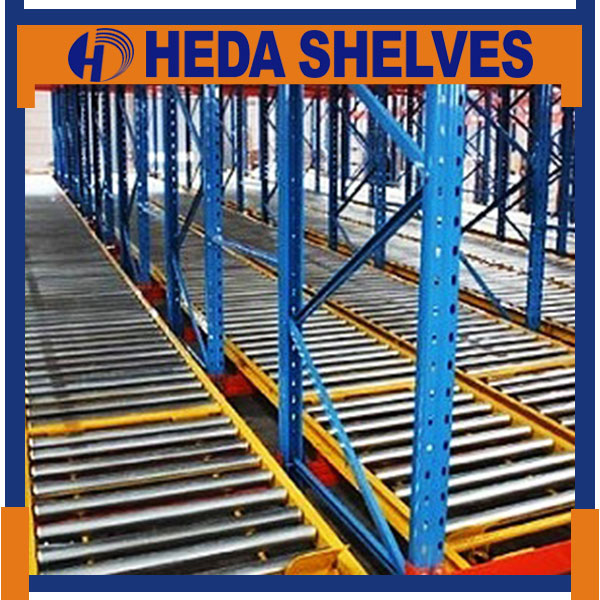
Close-up of HEDA pallet flow roller tracks between blue steel rack uprights
STRUCTURE 01

Gravity Roller Lanes

Steel roller tracks provide continuous pallet support along the storage lane and allow gravity-assisted movement. The required roller layout, supports and flow-control components depend on pallet characteristics and load conditions.
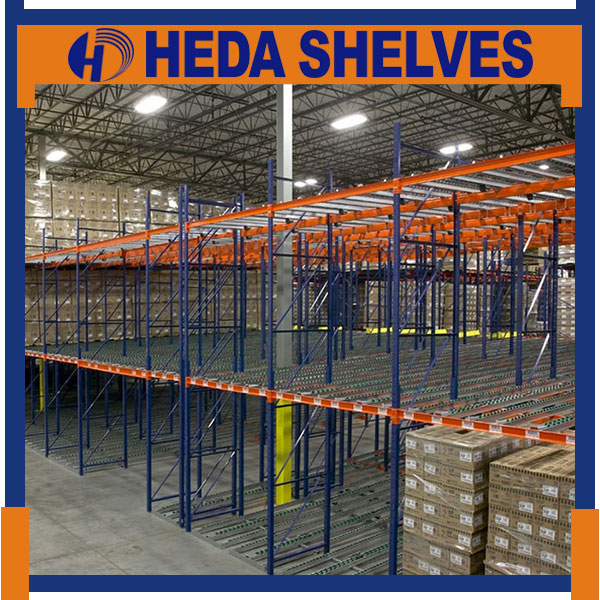
Industrial warehouse gravity flow racking with blue steel uprights and orange support beams
STRUCTURE 02

Heavy-Duty Rack Framework

Upright frames, beams and bracing support the multi-level pallet storage arrangement. Frame configuration, lane depth and structural connections are determined according to project loads and warehouse requirements.

Engineering note: Pallet flow design may require speed-control rollers, pallet separators, stopping devices and other safety components. Their configuration must be verified for the actual pallet type, load and operating conditions.

Why Choose Pallet Flow

Improve Storage Flow Without Adding More Access Aisles

Pallet flow racking is designed for warehouse operations that need deep-lane pallet storage while maintaining an organized first-in, first-out material flow.

01

Organized Stock Rotation

FIFO access supports systematic rotation of palletized products managed by production batch or inventory date.

02

Greater Storage Density

Multiple pallets can be positioned in depth within each lane, helping make efficient use of warehouse floor space.

03

Separated Loading and Retrieval

Loading and unloading typically take place at opposite ends of the system, supporting more organized material handling routes.

04

Reduced Deep-Lane Forklift Travel

Pallets move through the roller lanes under gravity, reducing the need for forklifts to enter the storage lanes.

Warehouse Applications

Suitable for High-Volume Pallet Storage Operations

Pallet flow racking is commonly considered where warehouses require FIFO stock rotation, deep pallet lanes and consistent movement of compatible palletized goods.

APPLICATION / 01

Food & Beverage Warehousing

Supports organized rotation of date-sensitive palletized inventory where FIFO handling is an important operational requirement.

APPLICATION / 02

Manufacturing & Finished Goods

Helps organize palletized production batches and finished goods moving from storage toward dispatch.

APPLICATION / 03

Distribution & Logistics Centers

Suitable for high-volume pallet handling where deep storage lanes and controlled replenishment support warehouse operations.

Custom Warehouse Engineering

Designed Around Your Pallets and Warehouse

Every pallet flow racking project requires a detailed understanding of the stored loads, pallet construction, storage depth and forklift operating conditions.

HEDA SHELVES provides project-specific racking configurations based on warehouse layout and storage requirements.

Final load capacities, rack dimensions, roller arrangement, lane inclination and safety components are subject to engineering review and pallet-flow verification.

Information for Your Custom Proposal

Warehouse dimensions, available height and floor plan
Pallet dimensions, pallet type and underside structure
Maximum loaded pallet weight and load distribution
Required pallet storage quantity, SKU mix and lane depth
Forklift type, handling direction and access
Daily pallet throughput and storage environment
Required inventory rotation and operational workflow
HEDA SHELVES / FACTORY-DIRECT SOLUTIONS

Planning a Pallet Flow Racking Project?

Share your warehouse layout, pallet dimensions, load weights and storage requirements. Our team can help you evaluate a suitable gravity flow racking configuration for your project.

GET QUOTE NOW
1. Light and medium upright

2. Heavy duty upright

3. Step beam

4. Box beam

HEDA SHELVES / CUSTOMER SUPPORT

Frequently Asked Questions

Find answers to common questions about our manufacturing, product customization, ordering, delivery and warehouse shelving solutions.

01 Are you a manufacturer or a trading company?

We are a manufacturer. HEDA SHELVES has specialized in manufacturing warehouse racking systems, supermarket shelving and various display stands since 2001.

02 Where is your factory located? Can I visit?

Our factory is located in Foshan, Guangdong, China. We warmly welcome customers to visit our factory. Please contact us to arrange your visit.

03 Are product samples available?

Yes, samples are available upon request. A sample charge applies, and the sample cost will be refunded when you place your next order.

04 Can you manufacture products according to our designs?

Yes. HEDA SHELVES has extensive experience in customized shelving and display solutions. We can manufacture products according to customer designs and project requirements.

  • Floor plans and 3D drawings can be provided by HEDA engineers.
  • Customized shelving layouts and configurations are available.
  • Our products support modular construction and integration into different store or warehouse layouts.
05 Can I order products in customized sizes and colors?

Of course. We welcome custom sizes and colors to meet different storage, retail display and project requirements.

06 Do you manufacture shelving and displays using different materials?

Yes. Our products are mainly manufactured from metal. We also produce shelving accessories and display solutions using materials such as:

  • Wood
  • Titanium alloy
  • Acrylic
  • Glass
  • Other materials according to project requirements
07 What is your production and delivery lead time?

Our general production lead time is within 15 days. The actual lead time depends on the order quantity, product design and customization requirements.

08 What are your payment terms?

Our standard payment terms are:

  • 30% deposit upon confirmation and signing of the Proforma Invoice (PI).
  • 70% balance paid by T/T before delivery.
09 How can my order be shipped?

We can arrange shipment using the following methods:

Option 1 — Sea Freight

Please provide your destination seaport. We will check and update the sea freight cost based on your shipping destination.

Option 2 — Customer-Nominated Shipping Agent

If you have your own shipping agent or freight forwarder, please provide their contact details. We will coordinate the delivery arrangements with your nominated agent.

10 What is your minimum order quantity (MOQ)?

Our minimum order quantity is generally 10 sets. Larger order quantities may qualify for more competitive pricing.

11 How can I get a quick and accurate quotation?

Since different customers and projects require different product sizes and specifications, providing the following information will help us prepare your quotation more efficiently.

For Warehouse Storage Racking

  1. Products to be stored: Tell us what items you plan to store.
  2. Storage method: Specify whether your products will be stored in cartons or on pallets.
  3. Weight and dimensions: Provide the unit weight and dimensions (Length × Width × Height) of each carton or pallet.
  4. Storage configuration: Tell us how many cartons or pallets you need per level and how many storage levels are required.
  5. Available space: Provide the dimensions of your storage area. A warehouse floor plan is especially helpful.
  6. Accessories: Specify any required wire decking, metal decking, wooden decking, safety bars, shims or other accessories.

For Supermarket & Retail Display Shelving

  1. Store layout: Provide the size of your retail space or a store floor plan.
  2. Products to display: Tell us what merchandise you plan to display and the required loading capacity.
  3. Preferred shelving style: Specify your requirements for metal or wood construction, dimensions, colors and design.

Not sure about the specifications? Simply tell us about your storage or display requirements. Our experienced sales team will help you develop a suitable shelving solution.

12 How do I install the shelving or racking system?

We provide step-by-step installation drawings for each type of shelving and racking system.

Our experienced team supports customers throughout the design, production and after-sales stages.

13 How are your products packed for shipment?

Our shelving products are generally flat-packed and protected with bubble wrap or protective film, using standard export cartons.

Other packaging options, such as wooden boxes, are also available according to customer requirements.

14 What is the difference between a starter rack and an add-on rack?

The main difference is the number of upright frames required.

  • Starter Rack (Main Rack): The first shelving unit in a row, supplied with two upright frames.
  • Add-On Rack: An extension unit that uses one additional upright frame and connects to the preceding rack.

Example: For a continuous row of 15 wall shelving bays, the configuration would be 1 starter rack + 14 add-on racks.

We use Cookies to improve your browsing experience. By continuing to use this website, you agree to our use of Cookie.