
One or Two Pallet Positions Deep
Select a direct-access rack layout or a two-deep storage arrangement based on operating needs.


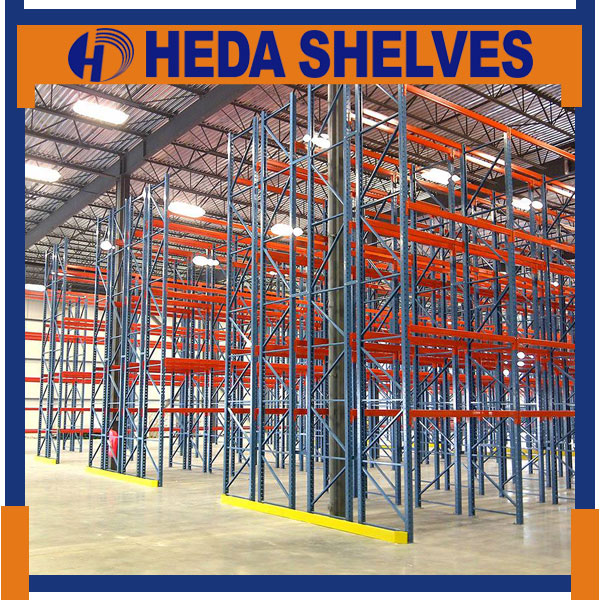
HEDA SHELVES Single/Double Deep Pallet Rack System provides configurable storage for palletized warehouse inventory. Single-deep racking allows direct access to each pallet position, while double-deep arrangements place pallets two positions deep to improve storage density. The appropriate system depends on pallet specifications, warehouse layout, stock rotation and forklift capabilities.
Select a direct-access rack layout or a two-deep storage arrangement based on operating needs.
Double-deep positions require suitable extended-reach handling capability and adequate clearances.
Compare storage position quantity, pallet accessibility and stock turnover before selecting the rack depth.
Single-deep and double-deep racking use similar pallet storage principles, but the depth of stored pallets changes accessibility. Double-deep storage can reduce the number of aisles required for a given storage objective, while reducing immediate access to rear pallets.
Each pallet position is located at the accessible front of the rack. Operators can select individual pallet positions directly from the aisle without first removing another pallet.
Suitable for warehouses managing more SKU locations, frequent pallet retrieval or inventory that requires direct access to each pallet.
The trade-off is that more aisles may be needed to provide this level of access.
Two pallet positions are arranged in depth from the same access aisle. The front pallet can restrict access to the rear pallet, so stock allocation and handling procedures must be carefully planned.
Suitable for larger quantities of similar palletized inventory where reduced aisle requirements can improve space utilization.
Rear pallets are not independently accessible when occupied front positions block the retrieval path.
The manufacturer's product page includes installation photographs showing different warehouse rack layouts. These are useful references for understanding frame construction, beam positions, warehouse aisle arrangements and storage surfaces. The final double-deep configuration must be approved separately.

The original manufacturer collage shows blue steel upright frames combined with orange horizontal beams. One view also includes wire mesh decking across selected storage positions. The images illustrate possible installation details, not a standard included accessory list.

The second manufacturer collage shows loaded rack rows and warehouse access aisles. Storage layouts must be coordinated with the types of pallets, the required stock accessibility and available handling equipment. Rack geometry in these examples may differ from the final SDPRS01 project configuration.
A double-deep warehouse layout should combine suitable rack geometry, deep-reach forklift capabilities and an inventory management strategy. All three must work together to support practical daily operations.
Forklift equipment must be capable of placing and retrieving pallets from the second storage depth. Confirm reach, residual load capacity, lifting height and working clearances for the actual unit loads.
Rear pallet retrieval may require temporary movement of a front pallet. Group suitable SKUs and batches to reduce unnecessary handling movements and support the required stock rotation policy.
The warehouse layout should be based on the intended pallet positions, available floor space and forklift operating requirements. Fewer aisles do not automatically mean a fixed percentage increase in storage capacity.
The ideal balance between density and selectivity depends on your inventory, daily pallet movements and handling equipment.
Compare both systems against your actual warehouse processes, rather than choosing double-deep storage based solely on theoretical pallet capacity.
A high number of different SKUs with frequent individual pallet retrieval may favor direct-access single-deep storage. Larger groups of similar inventory may be better suited to double-deep arrangements.
Review inbound and outbound pallet movements. Double-deep storage may require extra handling to reach rear positions, affecting productivity where access is frequent.
Verify the forklift model, forward reach, lifting height, residual load capacity, mast clearance and aisle requirements. Not every standard forklift is suitable for double-deep pallet handling.
Confirm pallet length, width, loaded height, maximum weight and underside support design. These values determine suitable rack depth, beam positions and support requirements.
Where strict first-in, first-out control is essential, consider the additional pallet movements that may be needed to retrieve rear double-deep positions. The storage strategy must match inventory rotation requirements.
Evaluate building dimensions, rack rows, aisle widths, door locations, column positions and required clearances. Compare complete layout alternatives to determine the practical storage gain.
SDPRS01 is presented as a configurable single/double-deep pallet racking storage system. Exact dimensions, beam capacities, frame specifications and pallet positions should be confirmed through the warehouse project design.
Single-deep and double-deep rack layouts serve different inventory management requirements. Choose the arrangement that supports the required storage volume without creating unnecessary handling.
Compare direct pallet accessibility with potential higher storage density according to inventory turnover, handling frequency and SKU diversity.
Double-deep storage can be considered for larger quantities of similar raw materials or finished goods. Direct-access positions may be more suitable for fast-moving inventory.
Plan warehouse storage around loaded pallet dimensions, available space and forklift operating conditions. A suitable mix of single- and double-deep areas may be evaluated where appropriate.
HEDA SHELVES can discuss storage layout options based on your pallet specifications, warehouse floor plan and inventory requirements.
A practical comparison should consider how many pallet positions are needed, how frequently they are accessed and whether your handling equipment can operate safely within the layout.
Double-deep racking allows two pallet positions to be arranged in depth. This can reduce the number of access aisles needed and increase storage density compared with a comparable single-deep layout. Actual storage gains depend on the warehouse design.
In single-deep racking, pallet positions are generally directly accessible. In double-deep racking, a loaded front position can prevent direct retrieval of the rear pallet. The front pallet may need to be removed first.
Double-deep pallet storage requires equipment capable of reaching the rear pallet position. A suitable deep-reach or extended-reach configuration may be required. Forklift reach, capacity and clearances must be verified for the project.
No. In conventional double-deep racking, pallet handling is performed from the access aisle using extended reach. Drive-In racking provides deeper internal storage lanes that suitable forklifts enter. They are different storage systems with different operating requirements.
The product page does not publish a universal rated load for this model. Final allowable loading must be confirmed from the selected beam spans, upright frames, rack layout and actual pallet weights.
Yes. HEDA SHELVES accepts custom size and color requirements and can discuss storage layouts based on warehouse floor plans. Final sizes, components and loading specifications must be confirmed before production.
Share your pallet specifications, required storage positions, forklift details and warehouse floor plan. Discuss a suitable single- or double-deep pallet racking configuration with HEDA SHELVES.


Find answers to common questions about our manufacturing, product customization, ordering, delivery and warehouse shelving solutions.
We are a manufacturer. HEDA SHELVES has specialized in manufacturing warehouse racking systems, supermarket shelving and various display stands since 2001.
Our factory is located in Foshan, Guangdong, China. We warmly welcome customers to visit our factory. Please contact us to arrange your visit.
Yes, samples are available upon request. A sample charge applies, and the sample cost will be refunded when you place your next order.
Yes. HEDA SHELVES has extensive experience in customized shelving and display solutions. We can manufacture products according to customer designs and project requirements.
Of course. We welcome custom sizes and colors to meet different storage, retail display and project requirements.
Yes. Our products are mainly manufactured from metal. We also produce shelving accessories and display solutions using materials such as:
Our general production lead time is within 15 days. The actual lead time depends on the order quantity, product design and customization requirements.
Our standard payment terms are:
We can arrange shipment using the following methods:
Please provide your destination seaport. We will check and update the sea freight cost based on your shipping destination.
If you have your own shipping agent or freight forwarder, please provide their contact details. We will coordinate the delivery arrangements with your nominated agent.
Our minimum order quantity is generally 10 sets. Larger order quantities may qualify for more competitive pricing.
Since different customers and projects require different product sizes and specifications, providing the following information will help us prepare your quotation more efficiently.
Not sure about the specifications? Simply tell us about your storage or display requirements. Our experienced sales team will help you develop a suitable shelving solution.
We provide step-by-step installation drawings for each type of shelving and racking system.
Our experienced team supports customers throughout the design, production and after-sales stages.
Our shelving products are generally flat-packed and protected with bubble wrap or protective film, using standard export cartons.
Other packaging options, such as wooden boxes, are also available according to customer requirements.
The main difference is the number of upright frames required.
Example: For a continuous row of 15 wall shelving bays, the configuration would be 1 starter rack + 14 add-on racks.

