Large Storage Drive-in/thru Pallet Racking System - HEDA SHELVES
  • Large Storage Drive-in/thru Pallet Racking System
  • Large Storage Drive-in/thru Pallet Racking System
  • Large Storage Drive-in/thru Pallet Racking System
  • Large Storage Drive-in/thru Pallet Racking System
  • Large Storage Drive-in/thru Pallet Racking System
  • Large Storage Drive-in/thru Pallet Racking System

Large Storage Drive-in/thru Pallet Racking System

No.LDRSS01
Drive-in pallet racking is the ideal storage system for storing large quantities of homogeneous palletized products with low turnover, stored in a stacked manner, and is widely used in cold rooms and cooling rooms.
Download
View all downloads
  • Description

  • Specification

  • FAQ

HEDA SHELVES / DRIVE-IN & DRIVE-THROUGH RACKING MODEL LDRSS01
High-Density Pallet Storage System

More Pallets. Fewer Aisles.

HEDA SHELVES Large Storage Drive-In/Thru Pallet Racking System is designed for high-density storage of large quantities of similar palletized goods. Instead of providing a separate forklift aisle between conventional rack rows, the system creates deep internal loading lanes that forklifts can enter. Pallets are supported by dedicated rails within the racking structure, allowing multiple pallet positions to be arranged along the depth of each lane.

High-Density Storage Internal Loading Lanes Pallet Support Rails
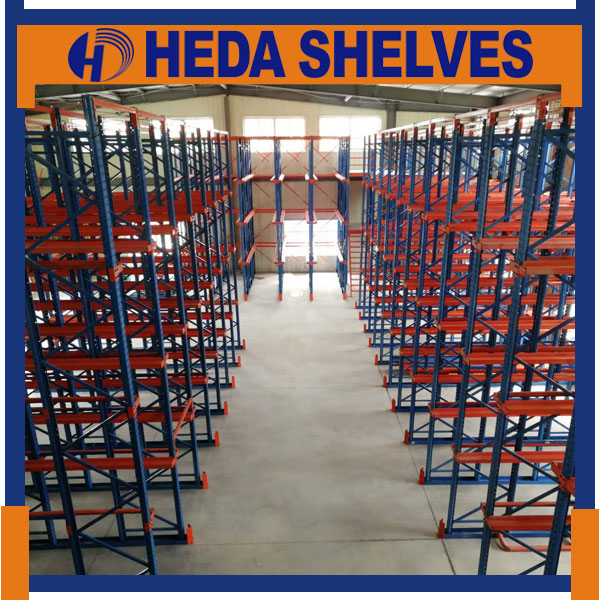
Original HEDA Large Storage Drive-In Pallet Racking System installed inside a warehouse, showing deep loading lanes, blue steel frames, orange pallet support rails and a central forklift access aisle

Original HEDA installation photograph — blue upright frames, orange support members and deep internal storage lanes.

01 / DENSITY

Deep Pallet Storage Lanes

Multiple pallets can be positioned along the depth of an appropriately designed loading lane.

02 / ACCESS

Forklift Entry into the Rack

Compatible forklifts enter designated lanes, reducing the need for separate aisles between rack rows.

03 / INVENTORY

Large Volumes of Similar Goods

A suitable solution for large batches of the same SKU or similarly managed palletized inventory.

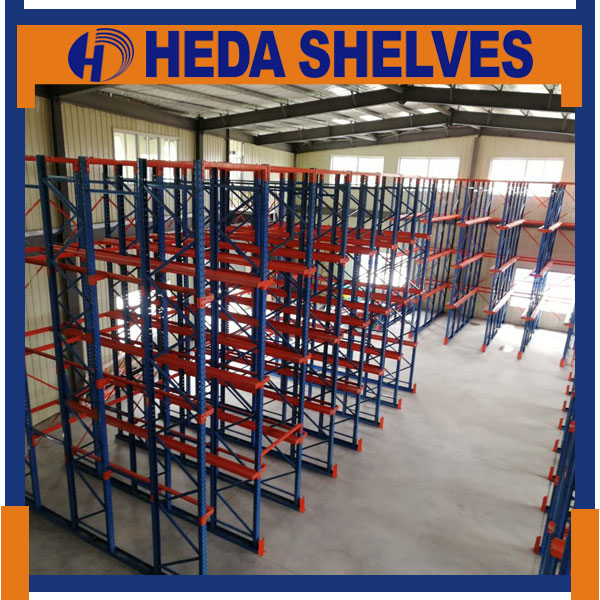
Angled original HEDA drive-in racking installation showing multiple deep pallet storage lanes, orange horizontal support rails, blue upright frames and diagonal bracing

Real rack installation showing repeated frame structures and pallet support levels extending along the storage lane.

Structural Storage Concept

Storage Depth Becomes Part of the Design.

Unlike conventional selective pallet racking, this system organizes storage around deep internal lanes. The rack structure includes upright frames, bracing and pallet support members arranged to create continuous storage positions along each lane.

01

Blue Steel Upright Frames

Repeated upright frames form the vertical structure for the deep storage system.

02

Orange Pallet Support Members

Horizontal steel support components establish the pallet-bearing positions along the storage lanes.

03

Diagonally Braced Frames

Blue diagonal members form part of the assembled upright-frame structure.

04

Forklift Loading Lanes

The spaces between the structural rack rows create designated routes for compatible forklifts to enter the system.

Original Product Structure

Pallet Rails Instead of Conventional Shelf Decking

In a Drive-In storage system, the pallet support arrangement is different from a conventional shelf or a standard selective rack bay. The photographed system uses orange support members installed within a deep blue steel structure.

Pallet Support Configuration

Engineered Around the Loaded Pallet.

A pallet must be compatible with its supporting rails, the loading lane and the required handling clearances. The final rail arrangement depends on the pallet dimensions, weight, base design and number of storage positions.

Pallet Support Rails

Support components run along the storage lane and are designed around suitable pallet bearing positions.

Rail Support Components

The rail support arrangement must transfer the specified loads into the supporting rack structure.

Entry and Handling Clearance

Pallet entry, forklift mast and operating clearance must be checked against the actual lane geometry.

Frame and Rail Compatibility

Upright profiles, connections and rail support components must match the approved system design.

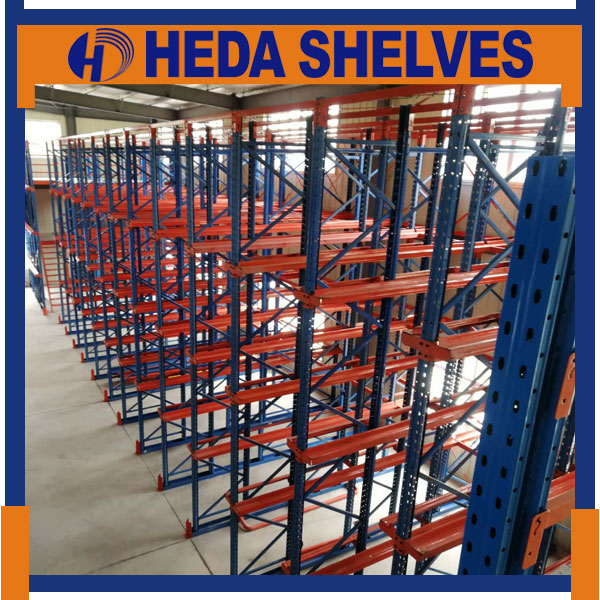
Original HEDA drive-in racking structural perspective showing blue perforated uprights, diagonal frame braces and multiple orange pallet support members extending into deep storage lanes

Actual HEDA product photo showing the orange support members and repeated blue upright frames.

Important structural distinction: This model is a Drive-In/Thru pallet storage system, not a standard selective rack. Pallets are supported by designated rail arrangements within deep loading lanes. Do not assume that solid metal shelves, wire-mesh decking or conventional front-to-back pallet beams are standard components of this photographed system. Final rail geometry, load ratings, connections and protective accessories must be confirmed for the approved design.
Storage & Inventory Management

Drive-In or Drive-Through?

Both configurations use compact storage lanes, but the entry and exit arrangement changes the possible inventory rotation method. The appropriate option depends on warehouse layout, handling requirements and stock rotation needs.

CONFIGURATION / 01

Drive-In Racking

A single-sided loading and unloading arrangement. Pallets enter and leave from the same end of the lane. Because pallets are stored at multiple depths, the system typically operates on a Last-In, First-Out (LIFO) basis.

P4 P3 P2 P1
ENTRY / EXIT ⇄ DEEPEST POSITION
Typical rotation: LIFO — Last In, First Out.
CONFIGURATION / 02

Drive-Through Racking

A two-sided loading lane with access available from opposite ends. Pallets can be loaded from one side and retrieved from the other. With a suitable loading sequence and operating process, the system can support First-In, First-Out (FIFO) rotation.

P1 P2 P3 P4
LOAD → → UNLOAD
Possible rotation: FIFO — First In, First Out, when appropriately designed and operated.

The diagrams illustrate stock-flow concepts, not exact lane geometry or loading instructions. Actual loading sequence, access directions and forklift movements must follow the approved warehouse operating plan.

Storage Efficiency

Designed to Make Better Use of Warehouse Space

Drive-In pallet racking increases storage density by reducing the number of separate access aisles required between rack rows. It is most effective when the stored goods and inventory process are suited to deep-lane storage.

01

Higher Storage Density

More of the available floor space can be allocated to pallet positions rather than individual access aisles. The actual gain depends on the warehouse layout.

02

Efficient Batch Storage

Suitable for large quantities of homogeneous palletized goods that can be managed together within a storage lane. Each lane should follow a defined inventory policy.

03

Suitable for Temperature-Controlled Storage

Dense pallet storage can be useful in refrigerated and frozen warehouses where available space is costly. Steel finish, operating clearances and environmental conditions must be confirmed for the project.

Storage utilization reference: HEDA SHELVES describes potential space utilization of up to 85% for suitable Drive-In systems. This is a published product claim, not a guaranteed result. Achievable density depends on aisle arrangement, pallet size, storage height, forklift access and operating requirements.
Technical Configuration

Engineered for Your Pallets, Lane Depth and Forklift Operation

Drive-In racking must be planned as a complete structural and operating system. Pallet support rails, upright frames, clearances and load requirements all affect the final configuration.

Specification accuracy: This product page does not publish a fixed numerical rated load, dimensional table or upright thickness for model LDRSS01. These values should be confirmed through the project drawings and approved quotation. Do not apply the load ratings of unrelated selective pallet racking systems to this model.

Product & Project Configuration

Model LDRSS01
Product Type Large Storage Drive-In / Drive-Through Pallet Racking System
Storage Concept High-Density, Deep-Lane Pallet Storage
Structure Steel Upright Frames, Bracing and Pallet Support Rail Arrangement
Featured Colors Blue Frames / Orange Support Members
Access Configuration Drive-In (Single-Sided) / Drive-Through (Two-Sided)
Stock Rotation Typically LIFO for Drive-In; FIFO Possible for Drive-Through with Suitable Operations
Lane Depth Project-Specific; HEDA Describes Designs of 10+ Pallet Positions in Depth
Rated Pallet Load To Be Confirmed for Approved Configuration
Rack Dimensions To Be Determined by Pallet Size, Lane Geometry and Project Requirements
Forklift Compatibility Subject to Forklift Dimensions, Lift Height and Operating Clearances
Storage Environments Ambient, Refrigerated or Frozen, Subject to Approved Design
Accessories Entry Guides, Guards and Protection Components as Specified
Customization Lane Depth, Frame Height, Loading Arrangement and Project-Specific Configuration
Design & Operating Considerations

Important Details Before Designing a Drive-In Rack

Dense storage works best when the rack and material-handling operation are designed together. The following information is essential when evaluating the appropriate configuration.

01

Pallet Compatibility

Confirm loaded pallet dimensions, pallet construction, support direction and maximum unit-load weight. Pallet base geometry must be compatible with the intended support rails.

02

Forklift Clearances

Verify forklift overall width, mast dimensions, turning requirements, lifting height and safe operating clearance within the lanes.

03

Rail and Frame Loading

The complete structure must be rated for the specified pallet loads and distribution. Support rails, rail connectors, upright frames and anchoring must be checked as one system.

04

Entry Protection and Floor Conditions

Drive-In systems place handling equipment inside the rack. Appropriate entry protection, guidance, collision protection, floor condition and anchoring requirements should be reviewed for the site.

05

Inventory Rotation and Lane Assignment

Define which products will occupy each lane and determine whether LIFO or FIFO operation is required. Lane management should match actual product turnover and expiry requirements.

06

Cold Storage Conditions

For refrigerated or frozen environments, confirm operating temperature, steel finish suitability, handling equipment specifications and applicable warehouse safety requirements.

Industrial Applications

Designed for Large, Repeated Pallet Loads

The strongest applications for Drive-In racking are environments with relatively low SKU variety and high quantities of the same palletized products.

Application / 01

Cold Storage Warehouses

Dense pallet positions help make use of available space inside refrigerated and frozen facilities. Temperature requirements, stock rotation and equipment compatibility must be considered.

Application / 02

Bulk Finished Goods Storage

Suitable for manufacturing facilities holding large quantities of similar finished products on pallets. Lane assignment and access planning help coordinate storage and retrieval.

Application / 03

High-Volume Batch Inventory

A practical option for warehouses managing repeated batches of homogeneous palletized goods. The preferred stock rotation system determines the appropriate access configuration.

Custom Drive-In Racking Project

Configure the Storage Lanes Around Your Warehouse Operation

A successful Drive-In racking project starts with the pallets, required storage capacity and handling equipment. HEDA SHELVES can discuss lane arrangement, rack dimensions, pallet support rails and appropriate storage configurations.

Planning recommendation: Provide pallet specifications, the required number of pallet positions and forklift information. Also confirm whether inventory must follow a FIFO process, as this affects the drive-through access arrangement and warehouse layout.

Information Needed for Your Quotation

Type of palletized goods
Number of SKUs
Pallet length and width
Pallet base construction
Maximum loaded pallet weight
Overall loaded pallet height
Total pallet positions
Desired pallet positions per lane
Desired vertical storage levels
Available warehouse height
Warehouse floor plan
Forklift model and dimensions
Required stock rotation
Single or dual-side access
Storage temperature
Delivery destination

A warehouse drawing, photographs of loaded pallets and forklift specifications can help HEDA SHELVES evaluate the appropriate lane configuration and structural requirements.

Frequently Asked Questions

What to Confirm Before Ordering

What is the difference between Drive-In and selective pallet racking?

Selective pallet racking generally provides aisle access to individual pallet positions. Drive-In racking stores pallets in deep lanes accessed internally by compatible forklifts. It prioritizes storage density over individual pallet selectivity.

Can Drive-In racking support FIFO inventory management?

Conventional single-entry Drive-In systems typically operate on a LIFO basis. A two-sided Drive-Through configuration can support FIFO when designed and operated with suitable separate loading and unloading access.

How deep can the pallet storage lanes be?

HEDA SHELVES describes Drive-In systems with 10 or more pallet positions in depth. The practical lane depth depends on the rack design, pallet specifications, forklift capabilities and operating requirements. A fixed depth should not be assumed for every project.

What is the load capacity of this model?

The LDRSS01 product page does not state one universal rated pallet capacity. The allowable load must be confirmed using the selected upright frames, support rails, connections, lane geometry and actual unit-load conditions.

Can the system be installed in a frozen warehouse?

Drive-In racking is used in refrigerated and frozen storage applications. The selected materials, surface treatment, anchoring, forklift and operating procedures must be appropriate for the site's temperature conditions.

Is Drive-In racking suitable for many different SKUs?

This system is generally most effective for high quantities of similar products with relatively low SKU variety. Where many different SKUs require frequent individual access, the storage and retrieval implications should be evaluated before choosing a deep-lane layout.

HEDA SHELVES / HIGH-DENSITY WAREHOUSE SOLUTIONS

Planning a High-Density Drive-In Racking Project?

Share your pallet dimensions, required storage capacity, forklift specifications and warehouse floor plan. Discuss a suitable Drive-In or Drive-Through pallet racking configuration with HEDA SHELVES.

REQUEST A QUOTE →
1. Light and medium upright

2. Heavy duty upright

3. Step beam

4. Box beam

HEDA SHELVES / CUSTOMER SUPPORT

Frequently Asked Questions

Find answers to common questions about our manufacturing, product customization, ordering, delivery and warehouse shelving solutions.

01 Are you a manufacturer or a trading company?

We are a manufacturer. HEDA SHELVES has specialized in manufacturing warehouse racking systems, supermarket shelving and various display stands since 2001.

02 Where is your factory located? Can I visit?

Our factory is located in Foshan, Guangdong, China. We warmly welcome customers to visit our factory. Please contact us to arrange your visit.

03 Are product samples available?

Yes, samples are available upon request. A sample charge applies, and the sample cost will be refunded when you place your next order.

04 Can you manufacture products according to our designs?

Yes. HEDA SHELVES has extensive experience in customized shelving and display solutions. We can manufacture products according to customer designs and project requirements.

  • Floor plans and 3D drawings can be provided by HEDA engineers.
  • Customized shelving layouts and configurations are available.
  • Our products support modular construction and integration into different store or warehouse layouts.
05 Can I order products in customized sizes and colors?

Of course. We welcome custom sizes and colors to meet different storage, retail display and project requirements.

06 Do you manufacture shelving and displays using different materials?

Yes. Our products are mainly manufactured from metal. We also produce shelving accessories and display solutions using materials such as:

  • Wood
  • Titanium alloy
  • Acrylic
  • Glass
  • Other materials according to project requirements
07 What is your production and delivery lead time?

Our general production lead time is within 15 days. The actual lead time depends on the order quantity, product design and customization requirements.

08 What are your payment terms?

Our standard payment terms are:

  • 30% deposit upon confirmation and signing of the Proforma Invoice (PI).
  • 70% balance paid by T/T before delivery.
09 How can my order be shipped?

We can arrange shipment using the following methods:

Option 1 — Sea Freight

Please provide your destination seaport. We will check and update the sea freight cost based on your shipping destination.

Option 2 — Customer-Nominated Shipping Agent

If you have your own shipping agent or freight forwarder, please provide their contact details. We will coordinate the delivery arrangements with your nominated agent.

10 What is your minimum order quantity (MOQ)?

Our minimum order quantity is generally 10 sets. Larger order quantities may qualify for more competitive pricing.

11 How can I get a quick and accurate quotation?

Since different customers and projects require different product sizes and specifications, providing the following information will help us prepare your quotation more efficiently.

For Warehouse Storage Racking

  1. Products to be stored: Tell us what items you plan to store.
  2. Storage method: Specify whether your products will be stored in cartons or on pallets.
  3. Weight and dimensions: Provide the unit weight and dimensions (Length × Width × Height) of each carton or pallet.
  4. Storage configuration: Tell us how many cartons or pallets you need per level and how many storage levels are required.
  5. Available space: Provide the dimensions of your storage area. A warehouse floor plan is especially helpful.
  6. Accessories: Specify any required wire decking, metal decking, wooden decking, safety bars, shims or other accessories.

For Supermarket & Retail Display Shelving

  1. Store layout: Provide the size of your retail space or a store floor plan.
  2. Products to display: Tell us what merchandise you plan to display and the required loading capacity.
  3. Preferred shelving style: Specify your requirements for metal or wood construction, dimensions, colors and design.

Not sure about the specifications? Simply tell us about your storage or display requirements. Our experienced sales team will help you develop a suitable shelving solution.

12 How do I install the shelving or racking system?

We provide step-by-step installation drawings for each type of shelving and racking system.

Our experienced team supports customers throughout the design, production and after-sales stages.

13 How are your products packed for shipment?

Our shelving products are generally flat-packed and protected with bubble wrap or protective film, using standard export cartons.

Other packaging options, such as wooden boxes, are also available according to customer requirements.

14 What is the difference between a starter rack and an add-on rack?

The main difference is the number of upright frames required.

  • Starter Rack (Main Rack): The first shelving unit in a row, supplied with two upright frames.
  • Add-On Rack: An extension unit that uses one additional upright frame and connects to the preceding rack.

Example: For a continuous row of 15 wall shelving bays, the configuration would be 1 starter rack + 14 add-on racks.

We use Cookies to improve your browsing experience. By continuing to use this website, you agree to our use of Cookie.